

Some days, it can feel like you spend all your energy trying to figure out what your child will actually eat. You plan, cook, and make mealtime fun…only to watch them not eat what you made. It’s frustrating, not just because of the wasted effort, but because you want your child to enjoy food and feel nourished.
Still, it’s important to remember that not eating much as a baby (6 months to age 2) isn’t the same as being picky. Babies before the age of 1 year go through phases where milk feeds still meet the bulk of their nutritional needs.
Read more: Can a baby be picky?
Some toddlers can be distracted by new skills like walking, and that’s completely normal. It’s usually between the ages of 1 to 2, however, that things really begin to change.
Around the one year mark you may start to see some more food rejection, but by the time many toddlers are 2 years old, something called food neophobia often appears (the fear of trying new foods). Suddenly, your curious eater who once reached for everything on your plate becomes wary of any food that’s unfamiliar. It’s actually a developmental stage meant to protect them as they start exploring the world more independently. Understanding that doesn’t make it any less stressful when they reject foods you’ve lovingly prepared, but it can help you see their behavior in a new light.
What is neophobia?
In the context of feeding, it refers to a child’s natural hesitation or refusal to try foods that look, smell, or feel unfamiliar. This usually begins around the age of 2 (but can start earlier around 1 year), right when toddlers start to assert independence and test boundaries. While it can feel frustrating, food neophobia is actually a normal stage in development rooted in instinct, psychology, and biology.
Why Food Neophobia Happens
Food neophobia is actually thought to be an evolutionary protection mechanism. In early human history, young children needed to be cautious about what they ate. Refusing unfamiliar foods helped prevent them from consuming something harmful when adults weren’t nearby to supervise. For example: a poisonous plant may taste really bitter so they spit it out, but some other green vegetables may have a slightly bitter taste they aren’t used to as well. So at the dinner table, that ancient instinct lingers, showing up in your child’s sudden refusal to try new flavors, textures, or colors.
But biology isn’t the only factor. As children grow, they become more aware of control and autonomy. Food is one of the few areas where toddlers can exert real power by saying “no”, so mealtime becomes a stage for independence. What looks like stubbornness may actually be your child’s way of communicating: “I’m in charge of my body.” I know it’s difficult to remain calm when they do this, but establishing loving boundaries early on in the feeding journey will make all the difference.
Toddlers rely on familiarity as a source of security. They may only want foods they’ve seen often or recognize easily. Something as simple as switching the shape of pasta or serving a vegetable mixed with another food can trigger hesitation.
Common Triggers and Contributing Factors
While some level of neophobia is expected, several conditions can intensify it:
-
- Rapid developmental changes: Toddlers are busy mastering new skills like walking, climbing, and talking. Their brains are processing a flood of new information, and sometimes mealtime takes a back seat.
-
- Parental pressure: Hoping a child will eat what we make is natural, but too much persuasion can have the opposite effect. If a child feels pressured, eating can become stressful instead of enjoyable.
-
- Negative experiences: Gagging, choking, or being forced to finish a plate can lead to strong associations that fuel avoidance.
-
- Sensory sensitivity: Some children are more sensitive to textures, smells, and colors. A mashed food, for example, might feel overwhelming compared to something crisp or dry.
-
- Modeling and environment: Children learn by watching. If they rarely see adults enjoying vegetables or variety, they’re less likely to accept them.
What Food Neophobia Looks Like
Neophobia can take different forms. Some kids will refuse new foods outright while others may accept them one day and reject them the next. Common signs include:
-
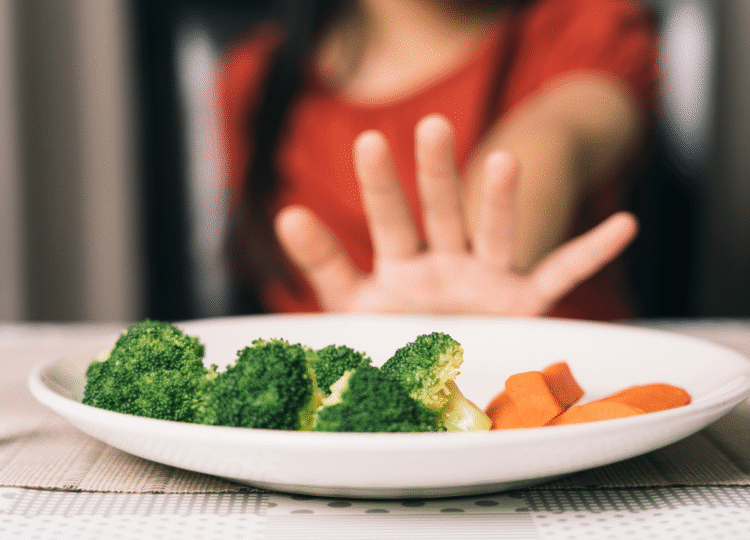
- Pushing food away or refusing to touch it.
-
- Eating only certain textures (like crunchy snacks but not soft foods).
-
- Wanting foods presented the same way every time.
It’s important to note that food neophobia differs from picky eating or feeding disorders. Picky eating often involves rejecting familiar foods or eating only a few preferred items. Neophobia, on the other hand, specifically involves fear or avoidance of new foods, and it’s usually temporary. You can read more about our tips for neophobia in BLW Meals app in our 2+ years section of the guides.
Helping Your Child Move Through This Phase
There’s no quick fix for food neophobia, but there are proven strategies that can make it easier for both parent and child.
- Keep offering variety without pressure.
Continue to present new foods alongside familiar favorites. A child may even need more than 15 gentle exposures before feeling ready to taste something new. Even seeing it on their plate counts as progress. - Model positive eating habits.
Children are far more likely to try foods they see you eating. Sit together at meals when possible, and show calm enjoyment rather than verbal persuasion. - Involve them in food preparation.
Toddlers love to help. Let them rinse fruit, stir batter, or place ingredients on a plate. Handling food builds curiosity and lowers fear. - Serve small portions and simple presentations.
Large servings or overly mixed meals can feel overwhelming. A few small bites in separate sections often feel more approachable. - Respect their appetite.
Trust that your child knows when they’re hungry or full. Forcing bites can create negative feelings around food and prolong the phase. - Avoid labeling your child as “picky.”
Labels can stick. Instead, describe what’s happening neutrally—“You’re still learning to like carrots”—to create a positive food identity. We talk more about this in our Tackling Picky Eating guide in the app. - Make food exploration playful.
Reading picture books about food, describing colors and shapes, or using food as part of sensory play (like sorting fruits by color) helps children learn without pressure.
When to Seek Help
Most children naturally move past food neophobia by ages five or six. However, if your child eats fewer than 10–15 foods total, loses weight, or shows distress around mealtimes, it may be worth consulting a pediatrician or feeding specialist. These professionals can assess for sensory sensitivities or other feeding difficulties that may need extra support.
Food neophobia is a developmental phase that almost every parent encounters. It may test your patience, but it’s not a reflection of your parenting or your child’s character. The key is to stay calm, keep offering variety, and focus on building positive experiences around food.
Feeding a child is just as much about building trust around food as it is about actual nutrition. When you stay calm, sit with them, and eat the same meal, you’re showing that mealtime is about connection, not control.
Resources:
1. Białek-Dratwa, A., Szczepańska, E., Szymańska, D., Grajek, M., Krupa-Kotara, K., & Kowalski, O. (2022). Neophobia-A Natural Developmental Stage or Feeding Difficulties for Children?. Nutrients, 14(7), 1521. https://doi.org/10.3390/nu14071521
2. Dovey, T. M., Staples, P. A., Gibson, E. L., & Halford, J. C. (2008). Food neophobia and ‘picky/fussy’ eating in children: a review. Appetite, 50(2-3), 181–193. https://doi.org/10.1016/j.appet.2007.09.009
3. Hazley, D., Stack, M., Walton, J., McNulty, B. A., & Kearney, J. M. (2022). Food neophobia across the life course: Pooling data from five national cross-sectional surveys in Ireland. Appetite, 171, Art. 105941. https://doi.org/10.1016/j.appet.2022.105941


Comments (1)
Why did feeding my baby feel easier before toddlerhoodsays:
em[…] Read more: Food Neophobia and Toddlers […]