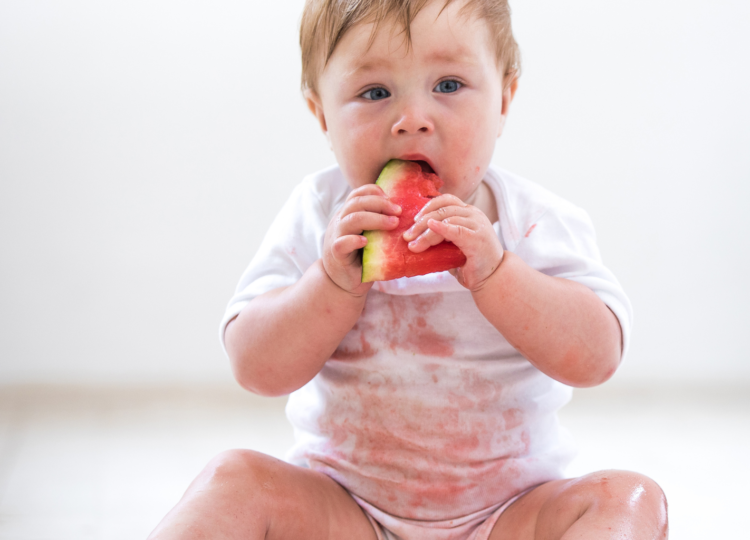

One of the most confusing and anxiety-provoking parts of starting solids with your baby is understanding the right food size. Most parents naturally assume that smaller pieces are safer because smaller seems easier to manage. However, when babies begin baby-led weaning and finger foods around 6 months, larger pieces of soft food are actually recommended. This standard is grounded in infant anatomy, motor development, and feeding safety.
Understanding the developmental “why” behind this recommendation can dramatically reduce fear and increase confidence at the table.
Baby Development at 6 Months: Why Food Size Matters
At around 6 months of age, babies have not yet developed refined fine motor skills. Instead of using their thumb and forefinger to pick up food, they rely on what is known as a palmar grasp, meaning they hold food with their whole hand. The more precise pincer grasp, which allows babies to pick up small pieces between the thumb and forefinger, typically develops closer to 8–10 months.
Because of this developmental stage, offering larger, stick-shaped or spear-shaped pieces of food when you start solids supports successful self-feeding. These shapes allow babies to grasp the food securely, bring it to their mouth independently, and better control how much of the food enters their mouth. Smaller pieces can be difficult for babies to pick up and may lead to frustration or accidental over-insertion before they have the oral skills to manage them safely.
When introducing solids around 6 months, food size should be chosen to support a baby’s developing motor skills, promoting independence and control during early self-feeding.
Oral Development and Choking Safety in Baby-Led Weaning
Another reason larger pieces are recommended when starting finger foods is related to oral development and choking prevention. At 6 months, babies do not chew like adults. They mash food using their gums and move it around their mouth with their tongue and jaw. Even without visible teeth, the hard ridges under their gums are strong enough to break down soft foods safely.
Larger pieces allow babies to gnaw, mash, and explore textures at their own pace. Smaller pieces of food, especially firm ones, are more likely to slip toward the back of the mouth before a baby is ready to swallow.
This is also where understanding the difference between gagging and choking is essential. Gagging is loud, dramatic, and protective. It is a normal reflex that helps babies learn how to move food safely forward in their mouth. Larger pieces are more likely to trigger appropriate gagging, which supports learning and skill development. Choking, on the other hand, is silent and dangerous. Small, hard pieces are more likely to pose a choking risk when babies lack the coordination to manage them.
Offering appropriately-sized, soft foods actually supports safety during baby-led weaning. Our free food library in BLW Meals app shows you how to safely prepare and serve a variety of foods to your baby.
How Bigger Pieces Help Babies Learn to Chew
Larger pieces of food also encourage pace control. When a baby tries to put a large piece of food entirely in their mouth, they are forced to take smaller bites since it cannot fit. This helps them practice biting, chewing, and regulating how much food enters at once.
One of the core principles of baby-led weaning is allowing babies to control their intake. Bigger, soft pieces naturally slow the process and promote skill development.
Some Examples of Safe Finger Food for 6 Month Old Babies
Size matters, but texture matters just as much. All foods offered during early baby-led weaning should be soft enough to easily squish between your fingers. If you cannot flatten it with gentle pressure, it is too firm.
Read more about how to serve.
Safe finger food examples for 6 month olds include soft-cooked vegetables cut into sticks, ripe avocado slices, soft strips of omelet, and well-cooked meat that is shredded or cut into large, tender pieces. These options support oral development, self-feeding skills, and choking safety when prepared correctly.
The Bottom Line on Food Size When Starting Solids
When babies first begin finger foods at 6 months, bigger pieces of soft food support safety, skill development, confidence, and independence. Smaller pieces will come later, once babies develop a pincer grasp and more advanced chewing abilities.
If offering larger pieces feels uncomfortable, you are not alone. Starting solids can feel overwhelming. But when you understand the developmental reasoning behind these recommendations, it becomes much easier to trust the process.
For more evidence-based guidance on baby-led weaning, safe food sizes, choking prevention, and texture progression, BLW Meals App provides step-by-step support designed to reduce fear and simplify feeding.
References:
Fangupo, L. J., Heath, A. M., Williams, S. M., Erickson Williams, L. W., Morison, B. J., Fleming, E. A., & Taylor, B. J. (2016). A baby-led approach to eating solids and risk of choking. Pediatrics, 138(4), e20160772. https://doi.org/10.1542/peds.2016-0772
American Academy of Pediatrics. (2022). Starting solid foods. HealthyChildren.org. https://www.healthychildren.org
Rapley, G., & Murkett, T. (2010). Baby-led weaning: Helping your baby to love good food. The Experiment Publishing.
National Health Service. (2023). Your baby’s first solid foods. https://www.nhs.uk
World Health Organization. (2023). Guiding principles for complementary feeding of the breastfed child. https://www.who.int